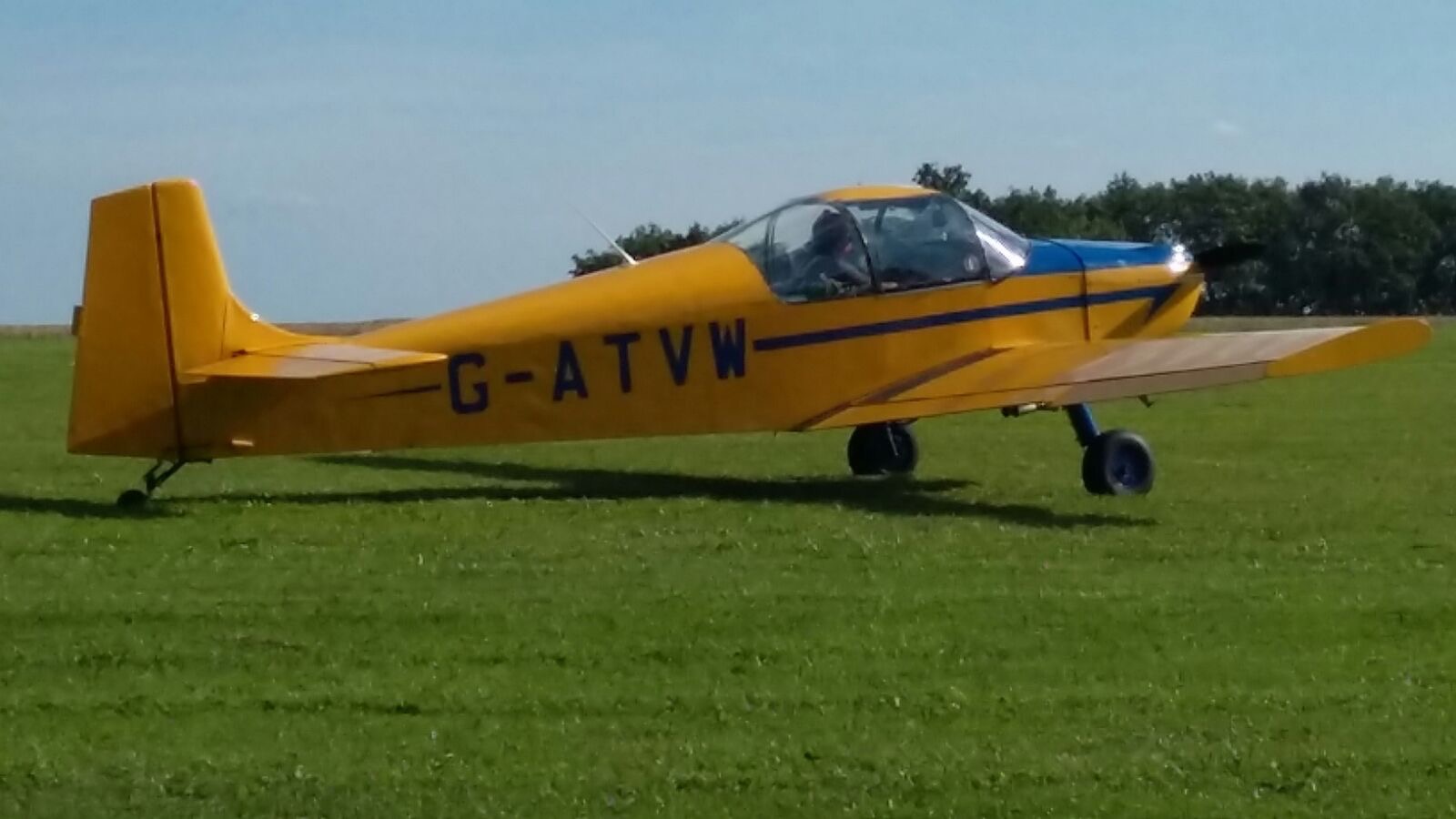
The Veritable Rollason Condor a true British Classic Vintage Aircraft
We all remember ‘the dogs we’ve loved’ as a well known saying much bandied about by the canine loving fraternity. I’m sure that readers will agree the same can be said of aviators and their aircraft. Some of us will only ever own and fly one aircraft in our entire flying careers. Whilst as others, with understanding partners and infinite financial resources, may own several types at various times throughout their lives.
Like most PPL’s I qualified in the backbone of the UK schools’ training fleet the venerable C150’s and C152’s, more commonly known as a ‘Spam Cans’. This was quickly followed with a Night Rating and then the IMC, now the IR(R) rating. Using that tried and tested chat up line amongst pilots when asked by a young lady as to what sort of aircraft they fly, the tongue in cheek reply being, ‘Well you’ve heard of the RAF’s large transport aircraft the Hercules C130?…ok, well I fly a C150!!’. Ladies soon wise up to this old gag, so I realised the way forward was to fly a real aeroplane….a tail dragger!
My brother was an already qualified ‘proper’ pilot and proud owner of a beautiful Jodel Mascaret which he kindly allowed me to use for my initial training. Before each sortie there would be a strange sight at the airfield as out would come a kneeling mat; I had added a prayer to my pre-flight check list! It is real seat of the pants flying, akin to learning to fly all over again…well it certainly was for me! Taming the tail dragger is not for the faint hearted. Once again, I found myself forever bashing the circuit attempting to get a handle on the damn thing. Needing to push the stick forward during the take off roll to raise the tail and gain rudder authority. Feet frantically going left, then right as though I was powering a peddle car to overcome the weather cocking swing tendency and keep the aircraft down the centre line. Then stick back on touch down to get that tail down for a perfect three pointer. Of course those initial landings were anything but perfect, I found myself bouncing more than the children’s TV character Zebedee! I had several flights with tail dragger pilots but whilst keen enthusiasts they weren’t instructors. I wasn’t mastering it at all. Just when I had got to the stage of hanging up my goggles in frustration, to my rescue came the legendary, late Don Headley, a retired fast jet jockey who upon leaving the RAF went on to a second career as a test pilot with the then Brough based Blackburn Aircraft Corporation, now BAE systems.
Don had enjoyed an amazing flying career strapping on many types from Tiger Moths to heavy metal fighter jets including the English Electric Lightning. Don had flown many test sorties in Phantoms and Buccaneers from the now defunct East Yorkshire airfield of Holme-on-Spalding Moor. When Holme-Upon-Spalding Moor finally closed Don was given the dubious honour of flying out the last flyable Phantom. The remaining lame ducks being carted off by road. This provided him with an opportunity too good to miss, to pull off an outrageous stunt. It was reported that Don did this by flying between the two hangars at below roof top height! Apart from those in the ATC watch tower there was no one else around to witness this low level stunt.
Anyway, back to the Condor, after a few circuits with Don, like a light bulb moment there was a click and I was greasing the Mascaret onto the runway. I was a proper pilot at last! Following my official ‘signing off’ by Don and full of confidence with my new found aviating skills I took my son for a flight. He was up from London visiting old school chums and had been out very late the night before and although suffering from a hangover he was keen to have a flight with me. Immediately after take off he fell asleep and didn’t wake up until we had landed and taxied to stop some 40 minutes later! Obviously it had been a very smooth flight finishing with a greaser of a landing as when he came round he enquired if we had taken off!
So the time had come to acquire a suitable little tail dragger of my own and I found a lovely little Rollason Condor, call sign G-AYFC, for sale. Originally operated on a C of A certificate by the Stapleford Flight Centre as an ab-initio trainer before going into private hands, transferring to the then PFA Permit certification and flying out of Nayland, Suffolk. By the time I had come around to purchasing Fox Charlie she was based in South Wales, being advertised at the princely sum of £10,500. This was in 1995. Following lots of letters, photos and phone calls, as this was long before emails, we settled on a price of £9k, subject of course to a successful test flight.
G-AYFC is a D62B variant, excellent on short field performance, but somewhat limited for touring with a maximum endurance of 3 hours flying time before everything goes quiet! So I always planned to be refuelling after 2 hours flying time. On the other hand there is the sheer fun of flying one. For the aviator who wants nothing more than to fly around the local manor on a lovely summer’s day, dropping in to farm strips or small GA airfields for the £50 brew then there can be no finer steed that the Rollason Condor. A true British ‘classic’ which is much underrated.
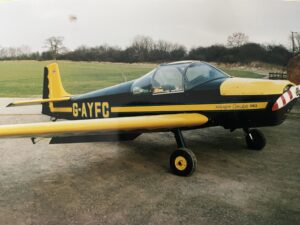
Fox Charlie on the apron at Battleflat Farm strip.
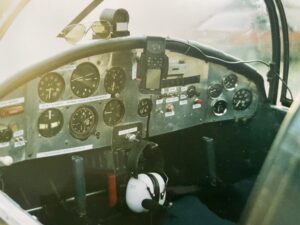
The office of Fox Charlie
The Condor’s limited endurance didn’t stop me venturing far and wide, regularly making trips to the south of the UK and even across a stretch of the Atlantic! Well 26 miles to be precise over to the Isles of Scilly or Scillies as they are referred to.
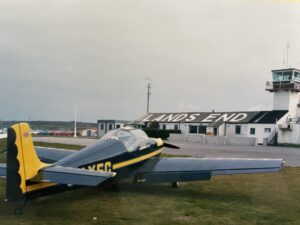
Guess where?
The Isles of Scilly do not have a supply of Avgas so as the old Merchant Navy saying goes, ‘Lands End for Orders’, in the aviation world it is ‘Lands End for fuel’!
Although generally associated with Rollasons, the Condor design was actually conceived by a Frenchman, Roger Druine. He is probably best known for his earlier attempts which produced the single seat open cockpit Turbulent. A favourite amongst some members of the Squadron. I recall watching a flypast of a ‘gaggle’ of Turbulents at a Squadron summer BBQ at Andrewsfield some 12 years or more ago.
Rollansons set up a small production run of the Turbulent with Druine’s permission in 1958. Sadly later that year Druine died of leukaemia.
Rollasons continued with the successful Turbulent production and decided to expand into the two seat market in direct competition with the Jodel and some US designs which were appearing on the UK register. The initial version, aimed at the ‘homebuilder’ market, was the D61 version which was designed to be fitted with either the Continental C65 or C75 engine. Rollason production followed with the D62 Condor which had many improvements incorporated. Three further variants followed, the D62A, fitted with the Rolls Royce 0200 engine, the D62B which had a 4 inches shorter fuselage and equipped with flaps the size of barn doors which makes it very stable in the approach configuration. Finally there was the D62C of which only four were produced. These were fitted with a larger canopy, larger wheels and tri-gear, but it never went into production; more’s the pity as it had the potential to be an excellent training aircraft. Had this come about then the aircraft may well have stolen the training market from the Cessna C150 range.
As mentioned, at the time of my purchase Fox Charlie was based at a small private airfield known as East Bach Farm, South Wales. The airfield is still there marked on the CAA half mill chart. My brother Nigel who is an accomplished tail dragger pilot agreed to accompany me along with my then wife, well someone had to drive the car home!
I vividly recall winding our way through the picturesque country lanes around Ross-on-Wye following the directions to the letter – as with emails this was pre-satnav days! At one stage we commented that there couldn’t possibly be an airfield amongst the undulating hills of this area, we hadn’t seen any flat land for over an hour concluding we must be lost. Then just as we came to the top of a particular steep hill, actually looking for somewhere to safely turn around and return to the main road, I saw a bright orange windsock billowing in the stiff breeze. Then we saw an old rickety gate with an equally old rickety wooden sign marked in faded lettering ‘East Bach Farm’ and the warning about entering an active airfield. Behind this there was a muddy track that meandered further up the hill towards the windsock. So we deduced that we had arrive at our destination, no shit Sherlock! Opening the gate and driving on to the track we observed another sign saying ‘Please Shut the Gate, sheep and aircraft on the lose’! Eventually after some slipping and sliding…my car at that time was a Jaguar saloon, not of the four wheel drive variety…we eventually came to the top of the hill to discover a large corrugated hangar and a small, rather old, weather beaten looking caravan with adjacent car parking. Getting out of the car we soon realised why the caravan was so weather beaten, perched here on top of the hill it was exposed to all the elements the south westerlies could throw at it. We discovered that we had come the back way to the airfield! Initially the place looked deserted but then several faces appeared at the caravan windows and like aviators the world over they came out to greet us with warmth and bonhomie, taking us inside and offering airman camaraderie along with tea and biscuits. The caravan may have looked worse for wear on the outside but inside it had obviously been lovingly kitted out and maintained by the resident flyers or more likely their partners as the decor had definitely been subjected to a cosy feminine touch.
Once the refreshments had been consumed we were eager to be see Fox Charlie and were ushered into the adjacent hangar to view my potential purchase. The bankers draft burning a hole in my pocket. As we were expected Fox Charlie had been moved around to sit at the front of the hangar, looking at the number of GA aircraft shoe horned into this one hanger the exercise of getting aircraft out appeared rather akin to mastering the intricacies of a Rubic Cube! The hangar contained a rare selection of vintage aircraft including a Tiger Moth which judging by the depth of dust adorning its wings hadn’t flown for some years, I’m guessing that would have been during the Second World War! Anyway sitting just behind the now open hangar doors resplendent in the weak, autumn sunshine was the dark blue and yellow Rollason Condor, G-AYFC. It was love at first sight and I couldn’t wait to fly her. “Hang on a minute though, where is the runway”? I enquired looking over the vista of the beautiful rolling hills of Ross-on-Wye. ‘Over there,’ stated the seller of FC with a broad smile pointing at the large grassed area that disappeared down the hillside giving the impression of a winter Olympics Salem but without the snow!! He went on to explain that the windsock was just for effect and to gauge the cross wind as it didn’t matter what the wind was doing, it is a matter of always taking off downhill and landing uphill…simple really!
‘Mmmm’….I thought looking down the runway as it fell away alarmingly in front of me. Having just barely qualified onto tail draggers I didn’t fancy the challenge of attempting a downhill take off. I hadn’t brought a change of underwear with me! My feelings of apprehension and trepidation weren’t helped as the other half jokingly asked if my Last Will and Testament was up to date! My experience of operating from grass strips with steep gradients would come later in my flying career but for now I bowed to my brother’s many hours experience on tail draggers. So following a discussion he volunteered to fly off with the owner for the test flight and I would meet them at the nearby Ledbury farm strip on the Welsh/English border which we were informed resembled a bowling green with good open unhindered approaches. I subsequently did, and following a good report from Nigel the bankers draft changed hands and we flew off to the farm strip near my then home where I had acquired hangar space to base Fox Charlie. This was Battleflat Farm which was just south of East Midlands Airport, parallel to their East/West runway and just under their 2500’ southern stub. Battleflat is sadly no more. Yet another airfield falling prey to the property developers and now covered with massive distribution warehouses. Hitler once accused Britain of being a bunch of shop keepers, albeit now we are warehouse keepers judging by the number of huge distribution depots that have mushroomed!
The easterly runway at Battleflat enjoyed an open approach but on the other hand landing on the westerly runway was a challenge as immediately across the 27 threshold running alongside the north/south railway was a line of telegraph poles and associated cables. This required nifty rudder and aileron work to slideslip and drop initially like a stone onto the numbers before balancing up, rounding out and greasing onto the smooth grass strip. This manoeuvre certainly classed the predominately westerly approach to Battleflat as the best ride in the park.
Taking off from Battleflat using the westerly runway and in the event of an EFATO there were many open fields into which performing a forced landing didn’t really present a problem. However, taking off in an easterly direction, as mentioned above there were the wires to be wary of but here again the length of the runway allowed sufficient height to be achieved with a good safety margin. But once over the wires if the engine failed one was presented with huge flat topped warehouses which would be rather like landing on an aircraft carrier if landing on top was the option selected! Whether the roof would stand up to the weight of a light aircraft landing on was thankfully never put to the test. There was however another couple of other options, if sufficient height/speed had been gained there were open fields to both the left and right of the industrial estate.
Battleflat Farm was one of the Flying Farmers group, owned and operated by farmer David Lees who operated a Cessna 180 from there. David who ran the farm singled handily is sadly no longer with us. With his passing the family, with no interest in aviation, followed the money by taking the opportunity to sell out to developers as the ever expanding nearby industrial estate started to surround the farm.
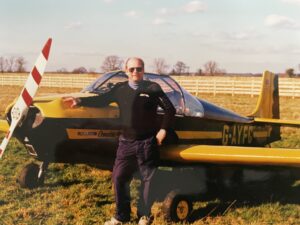
At a Vintage ‘Fly In’ at Finmere
Battleflat was jokingly referred to as Battleflat International by the Air Traffic Controllers at nearby East Midlands Aerodrome who always appreciated a call when departing or arriving even when not requesting a transit. Which as I explained was just beneath their Class D airspace. If ever I was departing to the north, and bearing in mind the Condor’s limited endurance, I would always request a direct transit through the EMA overhead rather than add on the extra time and fuel burn it would take to go around their ATZ either to the west or east. A transit I was never refused.
On returning to the airfield after a flight it was always an added enjoyment if using the westerly runway. As mentioned before we had to contend with the telegraph poles and wire necessitating in a stomach churning sudden drop to round out over the numbers. Being so close to and parallel to EMA runway it was not an uncommon occurrence to glance either left or right depending on the runway in use and see myself flying almost alongside 737’s and 747’s on final approach into EMA!
I recall one day close to Christmas. It was beginning to get dark, I was returning to Battleflat with about half an hour to spare before official dark although lights were beginning to come on below me! I had been speaking to EMA ATC and when I reported airfield in sight they instructed me to resume my own navigation into Battleflat. I’d been conscious that they were controlling a BA flight with a ‘Speedbird’ prefix call sign followed by 01 which meant nothing to me. Just as I was lining up on final approach I glanced to my right and there was Concorde paralleling me as it descended to land! Oh for a mobile phone with a camera to snap a shot, although in reality and for the safety’s sake I doubt there would have been time but certainly it would have been worth a ‘go around’ to get the shot! Often, if Air Traffic were very busy we could be on the ground before being able to ‘sign off’ with them. On such occasions it was customary to nip into the farm office and telephone just to confirm that we were safely on the ground. On this occasion and despite having ‘signed-off’ in the air I did phone to check that I hadn’t been seeing things and they confirmed that it was indeed Concorde landing after a Santa flight to Lapland! Despite the lack of a photo it definitely has a mention in my Flying Logbook.
 Refuelling at Pembrey…the only GA airfield with it’s own police force!

On the apron at Swansea International
Getting aboard a Condor requires a certain amount of agility. Each of the gull wing type doors hinge upwards and fasten together with a strap as there are no locking stays therefore care is needed in windy conditions, this is a simple and effective way of securing the doors. The cockpit glazing incorporates a fairly wide overhead panel which supports a very handy chart pocket. The door catches are simple swing over levers, secured by a secondary flip-over alloy safety catch along with an additional press stud strap for added security in the air. The cockpit is surprisingly roomy, not dissimilar in size to that of the Jodel Mascaret, although you are seated rather lower than in a typical Jodel. This however is not a disadvantage as the all round visibility is excellent. The flying controls are operated in real aircraft fashion by a centre-pivoted dual joystick. The handbrake is centrally mounted below the panel with a simple ratchet arrangement to hold it on when parked during power checks. The flap lever is situated between the seats and is probably the most awkward of the controls. It is rather short with the whole of the handle requiring pressure to release it from its selected position in order to select each of the two stages. Whilst the first stage is not a problem the second stage requires the flap lever to be almost in the upright position before the lever locks in place. This manoeuvre with the lever being pivoted directly abeam the pilot’s hip and the fact that the flaps are quite large therefore encountering some back pressure requires a certain amount of dexterity to master. However, once both stages are applied at the flap limiting speed of 70 knots the Condor comes down like a free fall parachutist, perfect for short field operation.

Approaching Caernarvon
In my Condor the only other item which could be referred to as inconvenient is the master switch described in the Condor pilots notes as the Ground/Flight switch, positioned awkwardly on the rear parcel shelf just aft of the pilot’s right shoulder. So, the system is to select the flight mode before strapping in to the three point harness otherwise you might strain something when operating the master switch! On the plus side it is impossible to switch off inadvertently in flight! The fuel tap is clearly marked and is down by the pilot’s left leg, while the fuel gauge is a bobbing rod which protrudes out of the fuel cap directly in front of the windscreen. See photo above. Although appearing to be rather crude it is a case of simplicity is often the best solution. Taking into consideration the unreliability of most aircraft fuel gauges this system is probably the most reliable so long as the rod does not get bent, causing it to stick! When the bobble on the top of the rod is sitting firmly on the surface of the fuel cap there is half an hour of useable fuel remaining. I have to say when it gets to this state with the bobble bouncing about due to turbulence it is a tad disconcerting! However, during my ownership I had on my PLOG drawn a small fuel management chart to reassure myself as to the fuel burn en-route. The Condor’s fuel tank holds a total of 68 litres useable which gives two and half hours flying time. Therefore on long distance route planning I would select my fuel stops within the two hour window. Weight and balance as with all aircraft has to be a serious consideration. The max all up weight is 669 kilos with a basic weight of 463 kilos, leaving a useful load of 206 kilos. Fuel and oil weigh in at 52 kilos leaving 154 kilos. The max permitted weight for luggage is 20 kilos. Of course these are the book figures. Factoring in say long wet grass or the summer heat I would never go to max AUW.
The instrument panel is spacious although Fox Charlie was only fitted with basic instruments. At the time I elected to fit a rudimentary straight line ‘Go To’ GPS and that was it! No colour moving map in those days. In fact for the first few years of my ownership it was charts, compass and ruler, along with Mark One Eyeball. I later fitted a VOR which was very useful.
Starting her up requires priming the engine with four or five pumps on the throttle selecting the mags to ‘on’ then hitting the starter bringing the engine to life. The mags were originally two switches but I soon had these changed to a ignition key type. Too easy to inadvertently switch off in flight! Also there’s the added shut down check of knowing they were off with the key out. Despite being a tail dragger it is unnecessary to weave during taxing as the view forward over the nose is quite good when compared to many other tail dragger types. The flat wing tips each sitting some 13’9” from the centre can easily been seen from either seat. Power checks are standard procedure for the 0-200, carb heat and mags check at 1800 rpm followed by an idling check. On lining up its flaps clean for take off, unless a short field take off is necessary. Apply full power watching the tendency to swing left as is the case with most US engined aircraft. However, the rudder is more than powerful enough to contain this. Hold the stick in the neutral position and she flies off the ground without any further encouragement. Best rate of climb at AUW is 570 fpm achieved at 60 knots. The Condor handles pretty much like a Jodel, although slightly slower. The aileron response and roll rate are appreciably better. The aircraft needs only small control movements and can be trimmed to fly hands off in smooth air. Cruising with 2450rpm set, the 0-200 engine fitted with an Evra prop will propel the Condor along happily at 90 knots IAS, burning no more than 20 litres per hour. There is nothing dramatic about the stall provided the ball is in the middle at the time of entering; the nose drops docilely straight ahead – only with full flap and partial power set will she tend to initiate a right wing drop. Recovery is standard and fast when pushing the stick forward a few inches with height loss of no more than two hundred feet. The Condor is cleared for spins if operated in the C of A category, however, Foxtrot Charlie was then on a permit so aerobatic manoeuvres were not permitted. However, in a spin Condors are known for their rapid rotation but again recovery is standard and can be stopped from either direction in just half a turn. Coming back into the circuit once the speed has decayed to the 70 knot flap limiting speed the technique is to deploy first stage of flap late on the downwind leg, then last stage on final. Setting the rpm to 1600 will induce the Condor to settle at the 60 knots approach speed. The view over the nose on final approach with full flap is very good, unlike some tail draggers, but care is needed with speed control as it is easy to allow the aircraft to

On a cold winter’s day at Full Sutton
fall behind the drag curve and sink rapidly if allowed to slow down too much. Equally it must not be allowed to gain excess speed which may exceed the fairly low Vf and anyway will result in a prolonged float at the roundout and flare. The roundout requires no more than an inch or so back on the stick, keep the Condor flying just a couple of inches above the ground as the stick is gradually eased back further to a three pointer touch down.
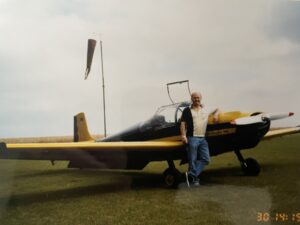 Fox Charlie and the author beneath the windsock at Mount Airy Farm
When my father died I was living in the Midlands so I was commuting between my local airstrip at Battleflat Farm near Coalville and ‘ooop’ north to be with my brother, Peter, so we could organise my father’s funeral arrangements. It was thus that I discovered a little gem of a farm strip at Mount Airy, South Cave, situated on top of the start of the East Yorkshire Wolds, literally just behind the old British Aerospace aerodrome at Brough and not far from where my brother lived in the village of Hessle to the west of Hull. Little did I know back then that one day I would become a resident at that strip by purchasing my own hangar there.

Another photo of the author sitting in the cockpit of Fox Charlie in front of the hangar I now own.
This other photograph taken of me in the cockpit of Fox Charlie is against the backdrop of the hangar I now own! Back then it was home to a very nice Trinidad Tobago owned by a local gentleman, Jeff Dale, who owned the Gamebore cartridge ammunition company based in Hull. It was through the efforts of the said gentleman that Mount Airy came into being some 30 years ago. Jeff kept his aircraft at nearby Brough but had to find it a new home when the closure of Brough was announced and aircraft owners based there were given notice to quit. Jeff initially put his Tobago at Humberside which is somewhat out on a limb and across the Humber Bridge. Jeff and the current farmer’s father, now retired, were old chums and the idea of putting in a strip at Mount Airy was born over a few beers in a South Cave hostelry. The rest as the saying goes, is history. Some years later I had returned to ‘home turf’ residing in the small village of Gilberdyke on the north bank of the River Humber, a mere 15 minute car journey from Mount Airy. Jeff’s son inherited the hangar on his father’s death but he isn’t an aviator and hadn’t advertised the fact that he wanted to sell the hangar. It was a pure coincidence that one day I found myself talking to a fellow pilot who owned the hangar next door to Jeff’s who informed me that it was apparently for sale. So exchanging phone numbers I was able to track down Jeff’s son, strike a deal, and bought the hangar.
The Rollason Condor has not in the past enjoyed a particularly good reputation. Let me tell you, the Condor is a terrific wood and fabric tail dragger aeroplane. It has exceptional handling characteristics and is eminently suitable whether used for local farm strip flying or medium distance touring. Without doubt with numbers now declining it is fast being considered a ‘classic’. One has recently change hands on AFORS for £14,500. For which the buyer got an awful lot of aeroplane.
I parted company with my Condor Fox Charlie in 2001 when I was deployed to Norway ‘standing-by’ the building of the famous ship ‘The World’. Naturally it sold very quickly. In 2013 I was delighted to come across her again at Breighton aerodrome in North Yorkshire near Selby.
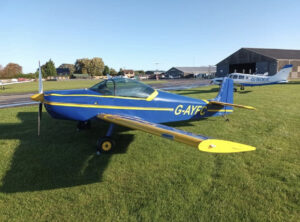
Fox Charlie in the summer sun at her new home at Sherburn-in-Elmet, North Yorkshire
Ironically this is almost next door to Mount Airy where I keep my Robin Regent. Fox Charlie was bought by a Breighton resident pilot, Andy Chadwick, who on taking ownership completely dismantled her and rebuilt the airframe adding a very practical and jet fighter looking sliding canopy. Andy also fitted smoke generators and having gained a display authorisation he regularly displayed Fox Charlie at General Aviation air shows throughout the summer months. Andy very kindly allowed me to fly Fox Charlie again and I am still in love with her to this day. Ironically, my brother Nigel and I now jointly own another Rollason Condor G-ATVW but then that is a story for another day. See the photo below.
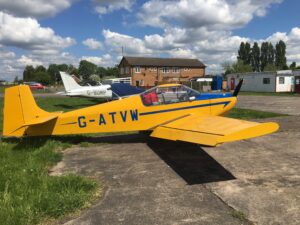
Victor Whisky under the summer sun at Sandtoft
Footnote:- Fox Charlie has recently changed hands and is now flown by a group based at Sherburn-in-Elmet and can be seen regularly doing what she is good at and that is bimbling around the local East Yorkshire/Lincolnshire area, dropping in at the many small airfield located there.
Not bad for a wood and fabric aeroplane conceived and built back in the 60’s.